
Published August 8, 2026 • ← Back to Blog
Typing "electrical services near me" into your phone usually brings up a long list of ads, directory pages, and trucks with flashy logos. What it does not show is whether the person who shows up at your Lynchburg door is licensed to do electrical work in Virginia, carries the right insurance, and will still be reachable if something goes wrong six months later. That gap is the whole problem. A panel upgrade, a failing outlet circuit, or a pre-listing electrical inspection is not the kind of job where you want to guess. You want proof.
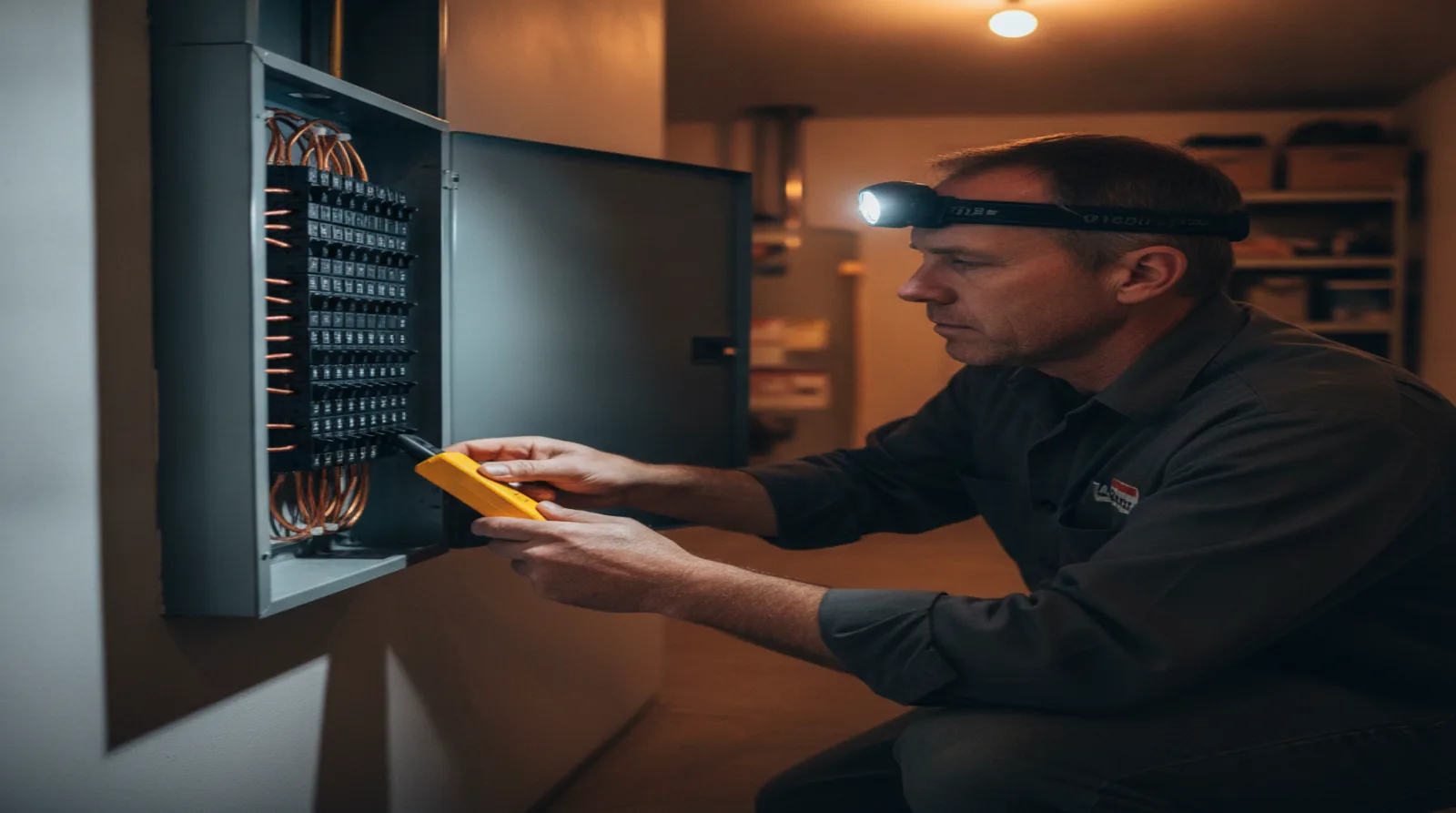
What "electrical services near me" really needs to return: licensed vs unlicensed work in Virginia
Virginia does not let just anyone wire a house. The Department of Professional and Occupational Regulation, through its Board for Contractors, issues contractor licenses in three classes. Class A contractors can take on large projects by total contract value. Class B contractors handle mid-sized work. Class C contractors are limited to smaller jobs. On top of that class, a contractor must hold the electrical specialty designation to legally perform electrical work. If the license does not list that specialty, the person is not authorized to do the job, no matter how handy they seem.
| License class | What it generally covers | Why it matters to a homeowner |
|---|---|---|
| Class A | The highest contract values | Used for major rewires, panel upgrades, and whole-house work |
| Class B | Mid-range contract values | Common for medium residential jobs and service upgrades |
| Class C | The smallest contract values | Suits repairs, additions, and limited circuit work |
Unlicensed electrical work is more than a paperwork issue. Work done without a proper Virginia contractor license usually skips the permit and inspection process. That means no independent check that the wiring meets the National Electrical Code and local amendments. If a fire or injury later traces back to unpermitted work, your homeowner's insurance may deny the claim. When you sell, disclosure forms and a buyer's inspector can flag work that was never inspected. Suddenly a cheap repair becomes an expensive problem.
Panel upgrades and electrical inspections are two of the most common reasons Lynchburg homeowners search for help. Both involve your main service equipment, grounding, and often the connection to the utility. Those are exactly the jobs where license class, electrical specialty, and permit compliance matter most.
How to verify an electrician's Virginia DPOR license
Before you hire an electrician in Lynchburg, check two separate DPOR licenses, not one. The first is the business license. The second is the individual license held by the person who will actually do the work.
The company must hold a Virginia contractor license from the Department of Professional and Occupational Regulation, Board for Contractors. That license has a class: A, B, or C. The class sets the size of contracts the business may take on. It also carries a classification or specialty that says what kind of work the license covers. A valid contractor license means the business is registered to contract for that trade. It does not mean every employee who shows up at your door is individually licensed.
- Business contractor license: class A, B, or C, with the right classification for electrical work.
- Individual electrical tradesman license: Journeyman or Master, for the person doing the work.
The electrician who steps onto your property needs an individual tradesman license from the same board. DPOR regulates individual tradesmen in electrical, plumbing, HVAC, and gas fitting work. For electrical work the individual levels are Journeyman Tradesman and Master Tradesman, and those are the only two. Virginia did add a residential-only pathway on April 1, 2025, but the DPOR Tradesman program limits it to HVAC mechanics and plumbers working in residential structures. There is no residential electrical tradesman license, so ask which of the two levels the person on your job carries.
This is the part homeowners often miss. A company can have a clean contractor license while the worker it sends holds no electrical tradesman license at all. Do not settle for checking the business alone. Ask for both license numbers, and make sure the individual license belongs to the person who will be on site, not just the owner or another employee.
You can verify both licenses through the public DPOR License Lookup on the DPOR website. Use it to confirm the license is active and current. If the person cannot or will not give you a license number, call someone else.
The 5 questions to ask before hiring: experience, insurance, permits, warranty, references
Once the license checks out, you still need to know how the electrician works. Ask these five questions before you sign anything.
1. How much experience do you have in Lynchburg homes like mine?
Older neighborhoods around Rivermont, Diamond Hill, and the Boonsboro area have different wiring conditions than newer subdivisions. A contractor who has worked locally for several years has probably seen knob-and-tube remnants, aluminum wiring, overloaded panels, and the quirks of local building departments. Ask for examples of similar jobs nearby. Experience with your specific type of home matters more than total years in business somewhere else.
2. Can you show me proof of insurance?
Ask for a certificate of insurance that names general liability and workers compensation. Electrical work carries real risk. If a worker gets hurt on your property and the contractor has no workers comp, you could end up involved in the medical bills. If a short damages your home and there is no liability coverage, you may pay for the repairs. Do not accept a verbal promise. Get the certificate.
3. Who pulls the permit and schedules the inspection?
For most electrical work in the Lynchburg area, the contractor should pull the permit from the city or county building department, depending on your address. The permit triggers an inspection after the work is done. That inspection is your safety net. If a contractor asks you to pull the permit, that is often a way to shift liability onto you. It can also mean the work will not be inspected at all. Make sure the written estimate states clearly that the contractor handles permits and inspections.
4. What warranty do you offer on labor and materials?
Materials often carry manufacturer warranties, but labor warranties vary. Ask how long the contractor stands behind the installation and what the process is if something fails. A written labor warranty is standard, but the exact term matters less than having it in writing. If the answer is vague or there is no written warranty, that is a warning sign.
5. Can you give me recent references from Lynchburg-area jobs?
References should be from recent jobs and from homes similar to yours. Call a couple of them. Ask whether the job started and finished on time, whether the permit and inspection went smoothly, and whether the homeowner would hire the electrician again. Online reviews help, but a direct conversation tells you more.
Red flags that should end the conversation
Some signals are strong enough that you should stop right there. Here are the ones that matter most.
- No DPOR license number or refusal to provide one.
- Cash-only pricing, no written estimate, or pressure to pay the full amount before work starts.
- The contractor asks you to pull the permit or says the work does not need one.
- No local address, no company vehicle, or a phone number that goes straight to voicemail every time.
- High-pressure tactics like a "today only" discount or claims that your panel is about to catch fire unless you sign immediately.
- Inability or unwillingness to show proof of insurance.
- An estimate that is far below every other quote without a clear explanation of what is left out.
Trust your gut. A professional electrician answers questions directly, writes things down, and does not make you feel rushed. If the conversation feels more like a sales pitch than a trade conversation, keep searching.
Why a vetted local network beats a cold directory search
Searching "electrical services near me" dumps you into a directory where anyone can buy a top spot. A referral network works differently. Blue Ridge Home Pro does not do the wiring itself. Instead, it connects Lynchburg homeowners with local electricians who have already been checked.
Every contractor in the network is verified against an active Virginia DPOR license with the electrical specialty. The business must have operated locally for at least three years. The owner passes a background check. There is no referral fee to the homeowner and no markup hidden in the price. You get introduced to a qualified local electrician, then you hire and pay that electrician directly. The same vetting applies across the network, whether you need an electrician or a handyman.
That pre-screening saves you from the worst part of a cold search: finding out after the fact that the person who worked on your panel was not licensed, was not insured, or has already disappeared. It does not replace the questions you should still ask, but it removes a lot of the bad options before you ever pick up the phone.
Ready to Hire?Get a Free Introduction to a Vetted Electrician
This is not abstract for us. The electrician in our network, Marshall Bowling, holds both the journeyman and the master license, which is exactly the distinction described above, and he is listed with those credentials on our contractors page. If you are ready to hire, start with a free introduction through Blue Ridge Home Pro. There is no cost to you, no referral fee, and no markup. You still choose the electrician, but you choose from a list that has already been checked for the license, insurance, and local track record that actually matter.